Category: Financal Literacy

The early American presidents had a very different view of money than most people today. We can still see their faces printed on the front of our bills, but their distant words of wisdom go mostly unheard.

They understood that having centralized control of an entire nations money supply is something that would not be in the best interest of the majority of people.

Thomas Jefferson once said,

If the American people ever allow private banks to control the issue of their currency, first by inflation, then by deflation, the banks and corporations that will grow up around them will deprive the people of all property until their children wake up homeless on the continent their Fathers conquered…. I believe that banking institutions are more dangerous to our liberties than standing armies…. The issuing power should be taken from the banks and restored to the people, to whom it properly belongs.

And he was right. That reality is already here.

  • 40 million Americans are living on food stamps
  • Millions more are homeless living in tents
  • And 80% of Americans are living paycheck to paycheck (in other words, broke).

Thomas Jefferson also said,

The modern theory of the perpetuation of debt has drenched the earth with blood and crushed its inhabitants under burdens ever accumulating.

And how true these words are. The Federal Reserve bank does nothing more than continuously debase the currency by printing more and more dollars, and raising the debt ceiling to greater highs. Those who are the most impacted by this are the poor. Without fair and equal access to financial literacy, the only thing that most people will do is consume liabilities, and continue to get crushed under the ever increasing burden of debt.

Since private central banks control the creation of money, and smaller banks distribute loans and credit, bankers own two-thirds of the entire worlds money supply. The divide between those who are rich and poor is as wide as the grand canyon.

In total, the United States is now over $30 trillion dollars in debt, inflation keeps rising, and its getting worse every day. But who can pay this debt back? The truth is, this is a debt that can never be repaid. It’s beyond that now, it’s growing at an exponential rate. But the tax laws still obligates every single working individual to pay federal taxes regardless.

Abraham Lincoln once said,

The government should create, issue, and circulate all the currency and credit needed to satisfy the spending power of the government and the buying power of consumers. The privilege of creating and issuing money is not only the supreme prerogative of government, but it is the government’s greatest creative opportunity. The financing of all public enterprise, and the conduct of the treasury will become matters of practical administration. Money will cease to be master and will then become servant of humanity.

He believed that only the government (and not any central bank) should have control over the distribution of wealth.

I think many would argue against this view, but the core of his argument is the same; he knew that private centralized banking would lead to huge divides between the rich and the poor and humanity would ultimately suffer as a result.

During his presidency, Abe Lincoln also attempted to solve this problem by issuing greenbacks, a (now defunct) paper currency that was created by the United States government and not any bank. But his idea never became a reality because he took a bullet in the back for trying to give African-Americans equal rights.

Today, the money-creation process is solely the privilege of the Federal Reserve System. Most people don’t realize that they are not a government agency — they are a private organization that was created in secrecy, and history shows that they covertly stole the money-creating power from the American people.

The recent move towards decentralized digital currencies like Bitcoin, is however, a very small push back, it’s a stepping stone towards giving this power back to the people by creating value in virtual currencies that operate in a peer-to-peer fashion without the need for any kind of middlemen. But who’s to say if this will even happen. It most likely seems that the ruling authorities will destroy it before they allow money to ever become privately owned by citizens. But what do you think?

Do you agree with the dead presidents? What do you think about the Federal Reserve bank? And do you think a new kind of peoples money, (like Bitcoin) would help? Leave your thoughts in the comments below.


Additional Resources


Disclaimer: This article was written for educational and entertainment purposes only. This is NOT financial advice. Always do your own research and please consult with a licensed attorney before making any serious investment. We are not responsible for any investment decisions that you choose to make.

Upon reading the title of this article, the majority of you readers will probably already have some kind of preconceived notion in your mind. Thinking about how to buy gold, you probably have some level of skepticism.

Some of you will think: Only rich people buy gold. or I can’t afford to buy gold.

But that is not true, because somehow we always seem to find the money to spend on things that we perceive brings value to our lives; such as eating out, or buying the latest iPhone or new clothes.

You can buy penny-sized coins of pure 24-karat gold for less than the price of a smartphone.

Others might think: I have no need for gold.

Do you have a need for money? It might surprise you to learn that the United States Dollar (USD) was originally created as simply an IOU for gold. Gold was/is real money. Whereas the US dollar is simply a currency.

Yes, paper currency only has value because the government says its legal tender. Merchants in America are obligated to accept nothing but USD (in paper or digital form) but its not real money. It’s an instrument that the government can use to control the currency and manipulate interest rates.

Still, others may think: Gold is not a good investment.

Again, this is also not true. Gold may not be the fastest growing asset class in comparison to some tech stocks, but it has exceeded 600% growth in the past 20 years alone. Gold can’t be printed like the US dollar, it’s resistant to inflation and it’s a reliable store of value.

Preconceived notions aside, none of above-mentioned assumptions actually answered the question posed in the title of this article. The question was: SHOULD you buy gold? Not if you can afford it, not if you need it, and not if its a good investment.

So, if you are ready, lets explore the real topic.

Exploring GOLD

As you ponder over these points related to gold, try to keep an open mind, because you might learn a few things that you never knew about what gold is.


When you buy something that is an investment (like a home or stocks) you expect the value to rise. That way you can eventually sell it with a profit, i.e. capital gains. With gold, this does happen but sometimes it happens very slowly. During those times, the stock market can easily outpace gold. They both seem to go back and forth, like a cycle.

A chart showing the Dow / Gold ratio.

That being said, it would not be wise to buy gold expecting a never-ceasing amount of capital gains from it. What you should expect is for gold to maintain your economic wealth as a store value over time.

So wait—if consistent growth doesn’t always happen with gold, does that mean stocks are just a better choice in general? Not at all.

In 1929 the American stock market was at the height of an immense bubble right before it totally crashed. When that happened, millions of investors got completely wiped out. Of course, no one can predict when and if this might happen again but the lesson is clear: those who had gold were safe. The price of gold went from $20.67 an ounce in 1929 to $35 an ounce in 1934, and it still continues to rise today.

Some may argue that holding gold is less safe than owning stocks or cash since these assets are now digital and can be safely stored in your bank or brokerage. And this fact cannot be denied, looking at history again the US government did at one time make it illegal for citizens to possess their own gold. In 1933 they issued Executive Order 6102. By means of this order the government demanded that all citizens hand over their gold to soften the blow of the great depression.

So Gold can indeed be confiscated or stolen by others who are desperate enough and willing to take what they think you might have. But that doesn’t mean that the exact same thing couldn’t happen to cash sitting in your bank account.

In 2013, the island nation of Cyprus experienced a banking debt crisis. To help pay their enormous bank debts the government decided to bail out the bank by taking the needed money from tax payers savings accounts, and by imposing daily withdrawal limits for everyone. The wealthiest depositors even lost up to 40 percent of their savings in one night. The people protested in the streets, but no one could stop it, it was too late. Their money was gone.

Thinking that this could never happen in your country is being overly optimistic, because anything could happen.

The US dollar is a fiat currency. (Fiat money is a currency established by government regulation, which has zero intrinsic value) If you look at history, every single form of fiat monetary system has eventually collapsed and went to zero.

History also shows that global reserve currency status does not last forever. At some point they all eventually have to leave the stage.

Global Reserve Currencies Since 1450

The US dollar has only existed as the world reserve currency since 1944 (when it was established by the Bretton Woods System) and that means it is about 79 years now since it first became a reserve currency. Most don’t last beyond 100 years. Whereas gold has been used to pay for goods since about 700 B.C. (almost 3,000 years ago) and it is still recognized as a store of value in every country on earth even today.

Beyond these facts, some people may still wonder about golds actual intrinsic value:

  • What makes gold so valuable anyway?
  • Why do people desire to own it?
  • Isn’t it just a piece of metal?
  • Just a shiny rock?

Well yes, it is those things but it’s also much more.

Gold is a rare, beautiful and precious metal. It can be melted and shaped into jewelry and it has other useful applications too, such as using it for technological components, like circuit boards and microchips. It conducts electricity well and it’s non-magnetic. It’s also biochemically inert, meaning that you can literally eat it (but please don’t) and it will pass through your digestive tract without causing any harm.

Every computer on earth today has trace amounts of gold and silver inside.

Gold is also one of the least reactive chemical elements on earth. It does not combine easily with oxygen, and although it can corrode, it doesn’t decay. It can literally shine forever. This fact alone makes it extremely valuable. But since it’s so rare, its counterpart (silver) is more widely used as an industrial metal.

How gold is made

Almost all the gold on earth was created within the geothermal core of our planet and small amounts eventually were pushed to the surface through volcanic eruptions. Scientists have said that theoretically they could create gold, but it would require a nuclear reaction so no one has managed to accomplish this thus far.

On the periodic table Gold is a chemical element with the symbol Au (from Latin: aurum) and atomic number 79, making it one of the higher atomic number elements that occur naturally. In its purest form, it is a bright, slightly reddish yellow, dense, soft, malleable, and a ductile metal.

So now we know that gold is a scarce, beautiful, rare metal that holds an intrinsic store of value. But perhaps you still feel that you have no reason to own gold? Well, here is more incentive:

Zero counter-party risk

Any time you store your money in a bank or keep your stocks in a brokerage there is always some amount of risk with the third party who is holding your money. The bank could go bankrupt, the brokerage can get hacked, and the stock market could suddenly crash. If any of those things happened, the gold that you own (provided its not kept in a bank) would be totally safe. This is why its recommended to keep your gold well hidden, or even better, keep it in a private vault. The wealthiest people keep their gold in private vaults all around the world. Even powerful governments own gold that they keep in vaults.

This is the reason why president Nixon took the US dollar off the gold standard in 1971. He knew that he had to keep gold reserves in America. If he had allowed gold to continue flowing overseas eventually America wouldn’t have had any wealth left. And this should tell you something: Gold is real money.

TIPS: Everyone should have some money set aside just in case of an unforeseen emergency. If your emergency savings are kept in gold:
1) it’s not so easy to quickly spend it,
2) there is zero counter-party risk, and
3) it is a reliable store of value and could even gain value.

With all of the above statements made, if you are still reading and if you still think you shouldn’t buy gold, please leave a comment. I think it’s wise to own multiple asset classes including physical gold bullion but I’d love to hear an opposing viewpoint.

If you don’t own Gold, you know neither history nor economics.

Ray Dalio

TL;DR Summary

  • You might think you cannot afford gold or have no need for gold or its not a good investment, none of these are true.
  • Gold can be confiscated or stolen, but the money you have in your bank account is also not completely safe.
  • Holding cash? The US dollar is losing value, and all other fiat currencies in history have went to zero.
  • You might feel pretty secure with money invested in stocks, but if those companies ever go under, so will your investments.
  • Gold is real money. Gold will always have value, but the US dollar won’t.

Additional Resources


Disclaimer: This article was written for educational and entertainment purposes only. This is NOT financial advice. Always do your own research and please consult with a licensed attorney before making any serious investment. We are not responsible for any investment decisions that you choose to make.

Knowledge is power. And the world today (including financial markets) is constructed in such a way that those with greater intelligence generally have a greater advantage (than those without the knowledge or education) to succeed. The more you learn, the better you can position yourself in life due to your increased awareness.

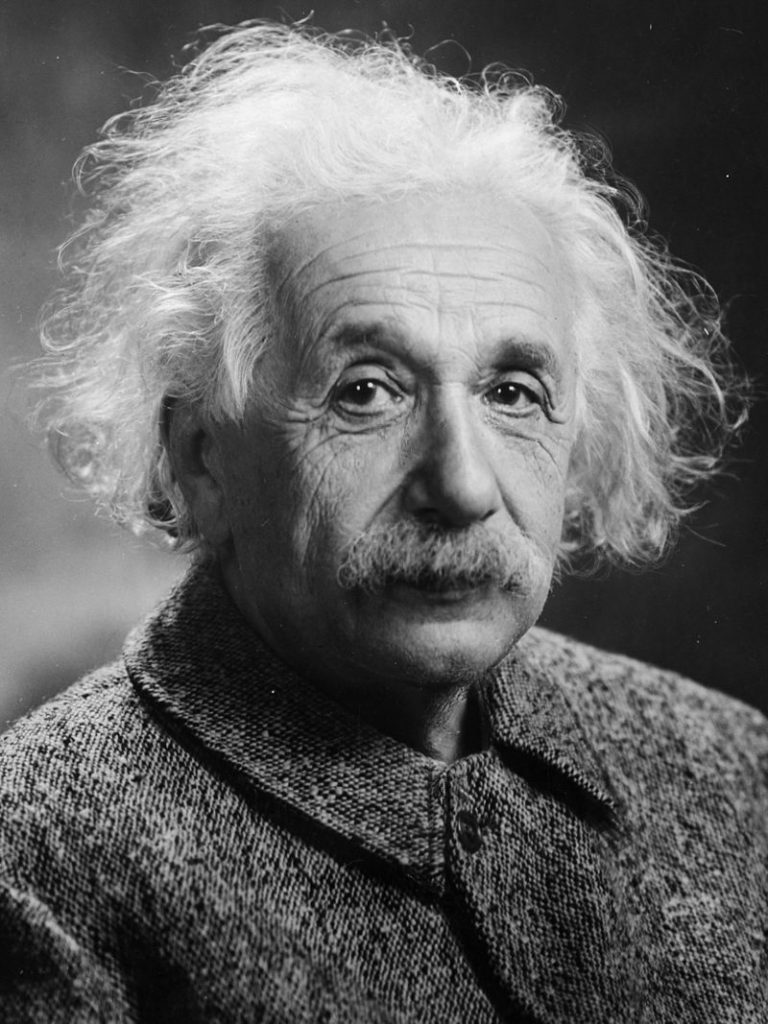
World-renowned physicist Albert Einstein also knew this. He knew that you need more knowledge before you can get more money. And one of the most profound aspects of money is compound interest.

Einstein once said,

Compound interest is the the eighth wonder of the world. He who understands it, earns it; he who doesn’t, pays it.

Unfortunately, most people today don’t understand the power of compound interest.

If you accumulated (saved) money, lets say at a rate of $50/week, after 6 months you would have over $1,000 dollars in your bank account. Now imagine if you both accumulated money and it compounded, meaning a small percentage (relative to the total size) was added each month. Then it would grow much faster.

Let’s consider an example.

Which of the two options would you rather have?

A) $1 million dollars right now, or
B) $0.01 cent that doubles every day, for 30 days

Many people would quickly choose option A and run. But option B is actually a better choice.

After just 30 days, option B = $5,368,709.12 !

Clearly, more money comes to those who are patient.

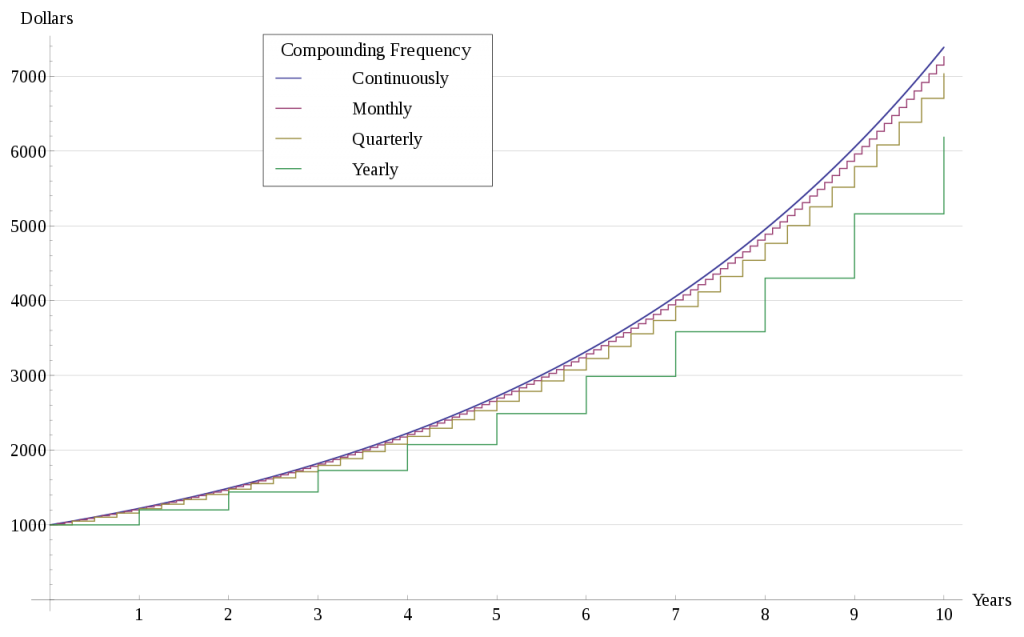
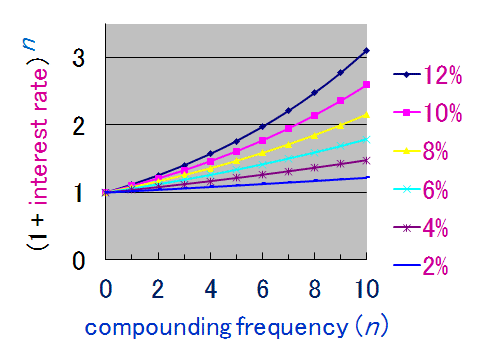
You might be wondering, How can that be? Well the fact is that things which compound, also grow exponentially. Let’s define this to better understand it.

Definition: ex·po·nen·tial growth (noun).
growth whose rate becomes ever more rapid in proportion to the growing total number or size.

Basically, as you begin to accumulate more and more, the size of your investment will keep growing faster and faster if it has any element that compounds. This behavior is actually a mathematical constant.

A mathematical formula

Math is nature’s way of saying, “this is truth.” And this is the mathematical formula used to express exponential growth.

A = final amount
P = initial principal balance
r = interest rate
n = number of times interest
applied per time period
t = number of time periods elapsed

You can choose to be on either side of the equation. Either someone who’s earning interest yourself, or someone who’s paying interest to others. But the choice is entirely yours, and it all depends upon how you choose to manage your money.

Most people don’t even bother to try to understand any of this, and it’s no surprise why they are always broke.

What banks do

Banks, credit card companies and money lenders are very aware of compound interest, and they use it every day to make millions of dollars. They call it an Annual Percentage Rate (APR) and this rate is basically a small percentage (in interest) that you pay them every month for buying something today, which you intend to pay off in the future.

APR is very small amounts of money, but when compounded over months and years it adds up to a substantial amount. And when you factor in thousands/millions of customers paying those interest payments, it’s enough to make the banker rich. And this is just one item in their bag of tricks.

So what is the point of all this? If you can understand compound interest, you can use it to your advantage. Instead of always paying interest to your credit cards and loans, you can earn it from them if you never carry a balance.

Take advantage of any opportunity you have to gain compound interest. Learn as much as you can about annual percentage yields, capital gains and dividends. Because if you don’t increase your financial intelligence, someone else who knows more about money will find a way to transfer it from your hand to theirs.


Disclaimer: This article was written for educational and entertainment purposes only. This is NOT financial advice. Always do your own research and please consult with a licensed attorney before making any serious investment. We are not responsible for any investment decisions that you choose to make.

There are many types of investors. Stock investors, real estate investors, crypto investors, and the list goes on. But in this article we will discuss a particular type of stock investor: the kind who focuses on dividends.

Lets say for example, you decide to purchase some shares of the Nike stock. When Michael Jordan releases a new pair of shoes, the sales from the shoe takes off. Nike makes profit from the sale. They turn around and re-invest the profit into the business. Then they pay a portion of the profit as a dividend to shareholders (you).

The more shares of a stock you buy, the more dividends you will earn. Not all stocks pay dividends, but some pay dividends yearly, others quarterly, and others monthly.

dividend is a payment made by a corporation to its shareholders, usually as a distribution of profits.

Wikipedia

Reaching financial independence

Financial independence is when your assets (investments) are large enough that they yield returns (dividends) to cover all of your expenses. Many investors view the point of earning $1000 in dividends each month as the first step towards financial independence.

Lets do some math, to figure out what it would take to get there with a relatively small stock. So lets take for example, Office Depot (ODP).

As of writing this blog, ODP costed about $3 per share. It returns a dividend payout of about $0.10 cents. So $1000 ÷ $0.10 = 10,000. And $3 x 10,000 = $30,000. So you will need 10,000 shares (approx $30,000) of ODP in order to see a dividend return of $1000 quarterly.*

You might be wondering why you should even care. What’s the advantage here? Here are a few things to consider.

1) Cash flow

A dividend is your share of the profits.

If you gain enough cash flow from dividends you could reach financial independence. What this means is no more trading hours for a paycheck. You’ll have your money working for you, to generate more money.

On dividend.com there is a long list of dividend stocks that will pay you every month. You can use these stocks to start to generate cash flow. If you invest in enough of these kinds of stocks, you can earn dividends almost every day.

2) Lower taxes

There is a Much lower tax liability. Your federal income taxes for those dividends is MUCH lower than your taxes from earned (job) income.

Dividends are taxed at 20%, 15%, or 0% rate, depending on your tax bracket. This means that the amount of taxes you pay on dividends will depend upon your earned income, and this of course may vary.

If you never purchased stocks or earned dividends before, don’t worry. It’s better to start at the bottom than not at all. And its also getting much easier to do so with apps like Robinhood and M1 Finance.

* (ODP pays quarterly, but many dividends pay monthly)


Disclaimer: This article was written for educational and entertainment purposes only. This is NOT financial advice. Always do your own research and please consult with a licensed attorney before making any serious investment. We are not responsible for any investment decisions that you choose to make.